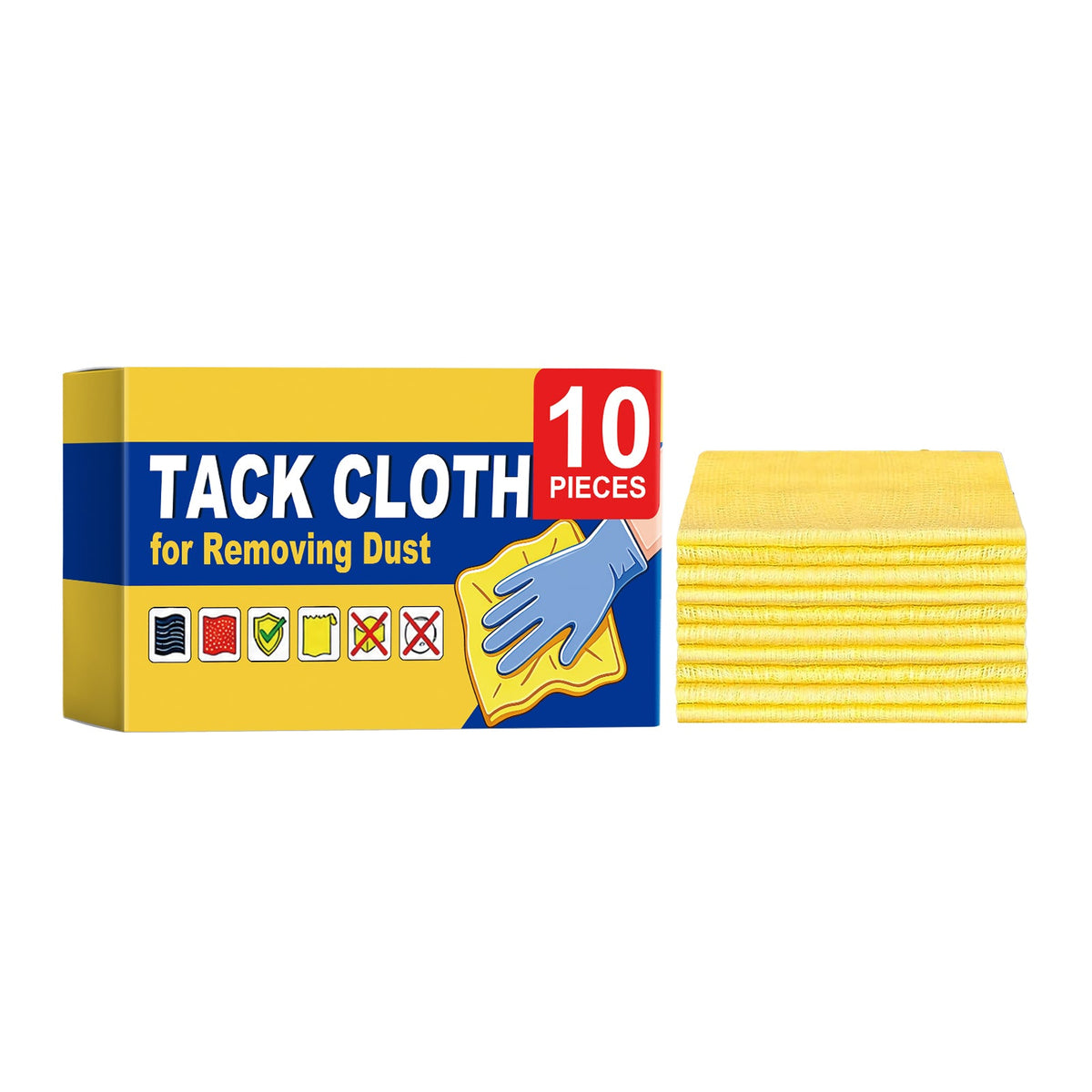
Tack Cloth for Removing Dust – Professional Grade Sticky Wiping Cloths, 10-Piece Pack for Automotive Painting, Woodworking, Metal & Surface Prep, Captures Dust Without Leaving Residue
Tack Cloth for Removing Dust – Professional Grade Sticky Wiping Cloths, 10-Piece Pack for Automotive Painting, Woodworking, Metal & Surface Prep, Captures Dust Without Leaving Residue
Couldn't load pickup availability

Tack Cloth for Removing Dust – Professional Grade Sticky Wiping Cloths, 10-Piece Pack for Automotive Painting, Woodworking, Metal & Surface Prep, Captures Dust Without Leaving Residue
💨 The Invisible Enemy Ruining Your Paint Jobs — And the One Tool That Stops It
You’ve sanded the surface perfectly. The grain is smooth, the primer is dry, the paint is mixed and ready. You roll on the first coat with care — and then you see it. Tiny bumps. Specks embedded in the wet paint. A surface that should be flawless is dotted with particles that hitched a ride on the brush or roller from the dusty air, the sanded surface, or the shop environment.
This is the most common — and most preventable — cause of poor paint finishes in automotive, woodworking, and home painting projects. Dust, lint, and fine particulates that are invisible to the naked eye until they’re trapped forever under a coat of paint or varnish.
The solution isn’t better paint. It’s better prep. Specifically, it’s a Tack Cloth — and this 10-piece professional-grade pack is the most cost-effective way to ensure every surface you paint is genuinely particle-free before a single drop of finish goes on.
🔍 What Exactly Is a Tack Cloth?
A tack cloth is a specialized wiping cloth that has been treated with a tacky, slightly sticky resin. This tackiness is calibrated specifically to attract and hold dust, lint, fine sawdust, metal filings, and other microscopic particles to the cloth’s surface — rather than simply pushing them around the way a regular cloth or paper towel does.
The physics are simple but effective: the resin creates a surface energy differential between the cloth and the particle. When the cloth makes contact with a dusty surface, the adhesion between resin and particle is stronger than the adhesion between particle and substrate. The particle transfers to the cloth and stays there, locked in the resin matrix.
Crucially, a properly formulated tack cloth does this without depositing any resin residue onto the surface. The tackiness is firm enough to capture particles but controlled enough not to contaminate the clean surface beneath — which is why tack cloths are trusted in professional automotive body shops, fine woodworking studios, and commercial painting operations worldwide.
🎨 Surface Prep Is 80% of the Final Finish: Why Professionals Know This
In professional finishing environments — auto body shops, furniture workshops, industrial coating facilities — surface preparation is treated with a seriousness that most DIY enthusiasts never apply to their own projects. Here’s what professionals understand that casual painters often don’t:
- 🔴 Paint does not hide particles — it immortalizes them. Every coat of paint or varnish applied over dust creates a permanent record of that dust in your finish. Sanding it out requires stripping back to bare substrate and starting over.
- 🔴 Sanding creates its own dust problem. The very act of preparing a surface — sanding, scuffing between coats — generates fine particles that settle back onto the surface within seconds in any workshop environment.
- 🔴 Standard cloths redistribute, not remove. A dry cotton rag or paper towel drags particles across the surface rather than capturing them, often creating electrostatic charge that attracts even more airborne dust before you can apply your finish.
- 🔴 Even “clean” environments have invisible contamination. Human skin cells, fiber from clothing, microscopic pollen — all of these can ruin a fine finish if not actively removed with the right tool at the right moment.
Tack cloths are the professional’s answer to all four of these problems simultaneously.
🚗 Automotive Painting: Where Tack Cloths Earn Their Reputation
The automotive finishing industry is arguably the most demanding environment for surface preparation in any consumer or professional context. A quality automotive paint job involves multiple stages — primer, base coat, color coat, clear coat — with surface preparation between each layer being absolutely critical to the final result.
Auto body technicians use tack cloths at every stage:
- 🔧 After initial sanding — to remove sanding dust from bare metal or existing paint before primer application
- 🔧 After primer application and primer sanding — the most critical tack-off stage, where primer dust is extremely fine and abundant
- 🔧 Between color coats — even in a spray booth, airborne particles can settle on wet paint; tack cloths catch any contamination between coats
- 🔧 Before clear coat — the stage where any remaining particle will be sealed permanently under the clear layer that defines the visual quality of the entire job
Our 10-piece pack provides enough cloths for a comprehensive single-vehicle full repaint job with multiple cloths per stage — or several smaller panel repair projects.
🪵 Woodworking & Furniture Finishing: The Secret to a Glass-Smooth Surface
Fine woodworking demands a level of finish quality that separates amateur results from professional ones. Whether you’re applying stain, oil, lacquer, polyurethane, or wax to a piece of furniture, cabinetry, or flooring, the texture of the final finish is determined almost entirely by the cleanliness of the surface at each stage of application.
Wood surfaces present particular challenges for dust removal:
- 🌲 Open grain structures in woods like oak, ash, and walnut act as reservoirs for fine sanding dust that is nearly impossible to fully remove with a brush or air blast
- 🌲 Wood fiber tearout from sanding leaves micro-fibers that stand up from the surface and become visible as “fuzz” under finish
- 🌲 Sawdust in the air settles continuously in any woodworking environment, repopulating a freshly cleaned surface in minutes
A single pass with a tack cloth immediately before finish application — after the surface has been sanded to final grit and any brush-off dust has settled — is the single most impactful preparation step for achieving a professional-quality wood finish at home.
🏠 Wall & Ceiling Painting: Why DIY Results Often Disappoint
Most homeowners who paint their own walls are frustrated by results that look fine at first glance but show texture problems in raking light or under certain lighting conditions. The usual suspects are roller texture and application issues — but just as often, the culprit is surface contamination that was never removed before painting.
Drywall dust from patching and sanding, old paint flakes from surface preparation, dust that settles on freshly primed surfaces — all of these create a contaminated substrate that traps particles under the new paint layer. Tack cloths applied to walls and ceilings after final sanding and dust-off deliver the same contamination-free surface that professionals achieve, without requiring a spray booth or professional-grade dust extraction equipment.
📊 The 10-Piece Pack: Designed for Complete Projects
We packaged these tack cloths in a 10-piece count deliberately. Here’s how a typical project consumes them:
- 🟡 1–2 cloths per major sanding stage on a standard furniture piece or wall section
- 🟡 3–4 cloths for a complete automotive panel repair (multiple prep and between-coat applications)
- 🟡 5–7 cloths for a full vehicle repaint with primer, color, and clear coat stages
- 🟡 8–10 cloths for a room-scale interior painting project with multiple coats and full surface prep
Each cloth is individually usable and can be refolded to expose fresh tacky surface as one area becomes loaded with particles. A single cloth used correctly will cover a surprisingly large surface area before it needs to be replaced.
🗣️ Hear From Professionals Who Use Tack Cloths Daily
“I run a small auto body shop and tack cloths are as essential as masking tape. We go through them constantly. This 10-pack is great quality at a price that makes sense for our volume. The tackiness is right — not too aggressive, doesn’t leave residue, works exactly as it should.”
— Derek M., Auto Body Technician, verified buyer
“I build custom furniture and the difference a tack cloth makes to the final finish is genuinely staggering. I used to wonder why my finishes looked slightly grainy compared to commercial pieces. Once I started tacking before every coat, the results became completely different. Smooth as glass.”
— Hannah L., Furniture Maker, verified buyer
“Just finished repainting our kitchen cabinets and used this pack throughout. Did both the cabinet boxes and doors, primed everything, sanded, tacked, painted. Zero dust nibs in the final finish. For a DIYer that’s honestly a first. These cloths made the difference.”
— Brian T., Home Renovator, verified buyer
⚠️ How to Use Tack Cloths Correctly for Best Results
Even a great tack cloth can underperform if used incorrectly. Follow these professional techniques for maximum effectiveness:
- Time it right — Apply tack cloth as the final step immediately before your finish coat. Don’t tack a surface and then leave it for 30 minutes — dust will resettle. Tack, then coat within minutes.
- Use light pressure — Gentle, even strokes are more effective than scrubbing. The tacky resin does the work; you just need to ensure full contact across the surface.
- Refold frequently — As the outer surface of the cloth loads with particles, refold it to expose a fresh tacky area. This extends the usable life of each cloth significantly.
- Don’t shake or snap — Shaking a tack cloth releases captured particles back into the air. Dispose of used cloths in a sealed bag.
- Work in one direction — Consistent directional strokes are more thorough than random wiping and help ensure complete coverage.
- Follow with immediate coating — The window between tacking and coating should be as short as practically possible. In a dusty environment, this can mean seconds, not minutes.
📦 Product Specifications
- 📌 Pack count: 10 pieces per box
- 📌 Cloth type: Professional-grade tacky resin-treated wiping cloth
- 📌 Color: Yellow (standard professional tack cloth color)
- 📌 Residue: No resin residue left on surface when used correctly
- 📌 Compatible surfaces: Automotive (metal, primer, base coat), wood, MDF, drywall, plaster, metal, fiberglass
- 📌 Compatible finishes: All standard paints, primers, lacquers, polyurethanes, varnishes, oils, waxes
- 📌 Not recommended for: Surfaces that will contact food directly, use on uncured resin surfaces
- 📌 Storage: Keep in sealed packaging when not in use to prevent drying of resin treatment